Evanescent and Emerging Spaces: Land/World Struggles of Palestinians and Guarani
- Wednesday 22 April
- 09:45
- —
- Thursday 23 April, 2026
- 16:30
- This event has passed
Booking information
Send an email to the organiser (Prof. Ioris).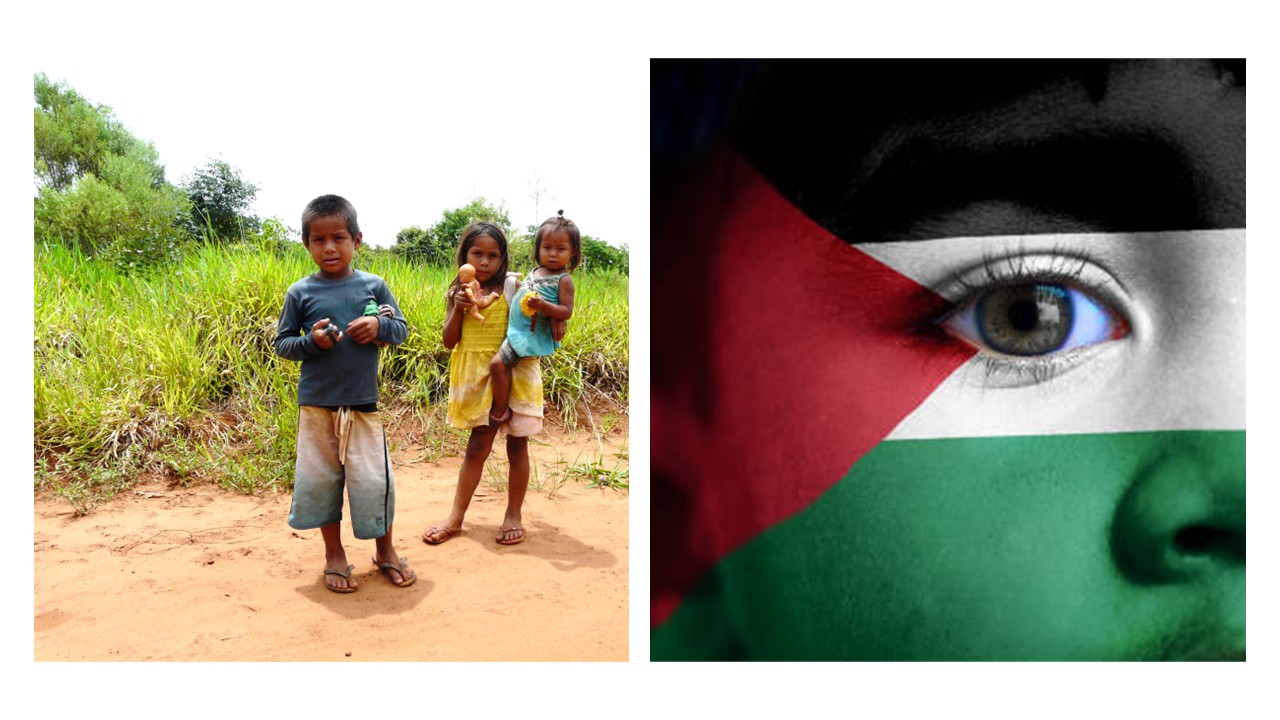
This event will confront important and disturbing parallels between the genocides of Palestinians and the Guarani in South America, and the challenges of resisting neocolonial land theft and world grabbing.
This international workshop will debate the enduring experiences of racism, aggression and displacement faced by Palestinian and Guarani communities (the latter living along the Brazil-Paraguay border). Both have endured the brutal pressures of state‑building, ethnic-based discrimination and exclusionary regional development. The processes have resulted in evanescent, but also emergent socio-spatial relations, which will be properly analysed.
The event will examine root causes, shared and divergent dynamics, and future pathways for justice, focusing on lessons from indigenous resistance to land grabbing and on how Wales can contribute to social, political, economic and environmental reparations (as well as radical and sustained transformations). Participants are called to engage critically, build cross‑border solidarities and translate these insights into concrete action, through advocacy, institutional pressure and sustained support for struggles for land, dignity and self‑determination.
Against the backdrop of an evolving literature on the geography of racism and indigeneity, the workshop focuses on the politico‑identitary responses of ethnic nations facing acute violence (including spurious real estate development) whose position differs from that of migrant or minority groups within a single nation‑state. Their ‘in‑between’ status across fragmented territories often intensifies discrimination while simultaneously strengthening claims for restoration, compensation and socio-spatial continuity. Through close engagement with representative organisations and public authorities, the event will develop a comparative framework structured around four interconnected objectives:
- Examine how state-building, frontier-making, and regional development act as catalysts for the marginalisation of ethnic nations across borders.
- Interrogate the dynamics of ‘emerging spaces’, including agency and contradictions, and explore restorative and reconnection strategies.
- Analyse the specific reactions of split indigenous nations to territorial dismemberment and land-related injustices.
- Jointly reflect on and theorise sub-national and cross-border responses to racism, and systematically disseminate insights through academic and policy-making engagement.
Through comparative analysis of analogous situations of injustice and marginalisation, this workshop will contribute to global debates on democracy, sovereignty and decolonial futures.
The event is FREE and OPEN to both the academic community and the general public. It will take place on 22–23 April in the School of Geography and Planning, Glamorgan Building, Cardiff University.
PROGRAMME
DAY 1 (22nd April)
9:45 Welcoming words (first day)
10:00 Prof. Sari Hanafi
"A New Imperial (Dis)Order"
10:45 Dr. Ahmad Sa’di
"Decolonising Palestine Indigenous Perspectives and Colonialism"
11:30 Prof. Asa'd Ghanem
"Israel from Oslo to Extermination: The Consolidation of the New Right and Its Consequences for Palestinians"
12:15 Dr. Sabrin Hasbun
"Out of the Blue: An Emerging Inner Space in the Palestinian Diaspora"
Lunch break
14:00 William Costa
"The Struggle for Land in Paraguay, Yesterday and Today"
14:45 Dr. Spensy Pimentel
"Indigenous Autonomies: Guarani-Kaiowa Community Resistance"
15:30 Keynote intervention: Prof. Jones D. Goettert
"Guarani-Kaiowa and the Contested Space of Public Universities"
Q&A session
16:00 Prof. Zahi Zalloua
"Anti-Zionism Is Not a Luxury"
16:45 Dr. Gabi Kirk
"Cultivating Sustainable Sovereignty: Palestinian Agrarian Lives in Transnational Focus"
18:00 Special talk: Prof. Ilan Pappé
"Gaza and the Occupied Territories: Israel on the Brink"
DAY 2 (23rd April)
9:45 Welcoming words (second day)
10:00 Rossandra Cabreira
"Struggle for Land and the Life of Resistance of the Guarani-Kaiowa"
10:45 Dr. Sharri Plonski
"Corridor Myths, Empty Spaces and Other Infrastructural Stories (from Gaza)"
11:30 Dr. Ran Greenstein
"Social Theory and Political Practice: What Lessons for Israel/Palestine from the Decolonization of South Africa?"
12:15 Dr. Athanasios Hassoulas
"Supporting Universities in Palestine: The Reponsibility of Wales"
and Dr. Matheus de Carvalho Hernandez
"Guarani-Kaiowa and the Responsibility of North/South Universities"
Lunch break
14:00 Dr. Abdalrahman Kittan
"Architecture, Power, and Resistance: Lessons from Palestine"
14:45 Zohra Wardak
"The ‘Moral Quandary’ of Occupation: Place, Power and Legitimacy in the Occupation of UK Campuses versus the Occupation of Palestine"
Q&A session
16:00 Concluding Words: Prof. Antonio A. R. Ioris
"Socio-Spatial Disputes, Decoloniality and Lessons from Palestinian and Guarani-Kaiowa Struggles"
Biographies
Ilan Pappé is Professor of History, Institute of Arab and Islamic Studies, and director of the European Centre for Palestine Studies, Exeter University. Prof. Pappé is a prominent but controversial historian whose work challenges mainstream narratives about Israel’s founding and the Palestinian experience. Educated at the Hebrew University of Jerusalem and the University of Oxford, he later became a professor in the UK. He is associated with the “New Historians,” a group that re-examined Israel’s early history using archival sources. His most influential publications include The Ethnic Cleansing of Palestine, A History of Modern Palestine and Ten Myths About Israel, all of which present a critical interpretation of Israel’s founding and its ongoing conflict with Palestinians.
Sari Hanafi is Professor of Sociology, Director of the Centre for Arab and Middle Eastern Studies and chair of the Islamic Studies programme, American University of Beirut, Lebanon. a Palestinian sociologist and public intellectual known for his work on migration, refugees, and the sociology of knowledge. Born in Damascus, Prof. Hanafi has held visiting positions at several international institutions. His research focuses on issues such as forced displacement, governance, and the role of academic institutions in the Arab world. Among his notable publications are Knowledge Production in the Arab World (co-edited, 2016) and The Oxford Handbook of the Sociology of the Middle East (co-edited, 2020), which explore intellectual life and social dynamics in the region.
Ahmad Sa’di is Associate Professor in the Department of Politics and Government at Ben-Gurion University of the Negev, Israel. He is the author of Thorough Surveillance: The Genesis of Israeli Policies of Population Management (2014) and Surveillance & Political Control towards the Palestinians (2013), and the co-editor of Nakba: Palestine, 1948, and the Claims of Memory (2007). He was formerly a Visiting Professor at the Universities of Waseda, Japan, as well as The National University of Singapore, Singapore, and Columbia University, USA. Dr. Sa'di has written extensively on memory and identity in conflict settings. His most notable publication is the co-edited volume Nakba: Palestine, 1948, and the Claims of Memory, and he has also authored numerous scholarly articles as well as the book Thorough Surveillance: The Genesis of Israeli Policies of Population Management, Surveillance and Political Control towards the Palestinian Minority (2013), which examines state practices toward Palestinian citizens of Israel.
Asa'd Ghanem is Professor of Comparative Politics School of Political Sciences University of Haifa, Israel. Prof. Ghanem's research interests include legal, institutional, and political dynamics of ethnic states and conflict, with extensive work on Arab–Jewish relations in Israel. He has written extensively on issues of democracy, nationalism and ethnic relations in divided societies. His work often examines the relationship between the Palestinian minority and the Israeli state, as well as models for resolving the Israeli–Palestinian conflict. Recent publications include Gaza — An Introduction to Continuous War. Beirut: The Arabic Institute for Research (2025, Arabic) and Violence and Crime among the Palestinian Minority in Israel: The Shattering of the Indigenous (with Nohad Ali, 2026).
Abdalrahman Kittana is a Palestinian architect, scholar, and researcher whose work examines urban resilience, architectural history, postwar reconstruction, and the intersections of cities and armed conflict. He is currently a Postdoctoral Fellow at Tampere University and an Assistant Professor in the Department of Architectural Engineering and Planning at Birzeit University in the West Bank. He earned his PhD in Engineering Sciences from KU Leuven, Belgium, in 2020. In 2019, he co-founded the Yalla Project, an interdisciplinary research-by-making initiative in Nablus dedicated to urban regeneration through collaborative practice.
Zahi Zalloua is Cushing Eells Professor of Philosophy and Literature and Director of Indigeneity, Race, and Ethnicity Studies at Whitman College. He is also editor of The Comparatist. His teaching and scholarship engage critical Black studies, the posthuman, and the Palestinian question. His most recent works include To Exist as a Problem: Being Black, Being Palestinian (forthcoming); Fanon, Žižek, and the Violence of Resistance (2025); The Politics of the Wretched: Race, Reason, and Ressentiment (2024); Solidarity and the Palestinian Cause: Indigeneity, Blackness, and the Promise of Universality (2023); Being Posthuman: Ontologies of the Future (2021); Žižek on Race: Toward an Anti-Racist Future (2020); Theory’s Autoimmunity: Skepticism, Literature, and Philosophy (2018); and Continental Philosophy and the Palestinian Question: Beyond the Jew and the Greek (2017).
Jones Dari Goettert is Professor of Geography, Vice-Chancellor and Principal of the Federal University of the Greater Dourados (UFGD), Brazil, with experience in the field of human geography, with an emphasis on Population Geography, working mainly on the following topics: frontier, migration, territory, individual trajectories, and geography and literature. Among his publications, it is possible to mention Lugares, Jeitos e Sujeitos (2005), O Espaço e o Vento Olhares da Migração Gaúcha para Mato Grosso (2008), Tempos e Espaços Civilizadores: Diálogos Com Norbert Elias (2009), Transfazer o Espaço (2011), Pequenas Geografias Guarani e Kaiowá: Relatos (2021, co-authored with Antônio Augusto Rossoto Ioris and Rosa Sebastiana Colman), and the series of five books Guarani e Kaiowá: Modos de Existir e Produzir Territórios (co-edited with Levi Pereira and Antonio Augusto Rosssotto Ioris) published betweeen 2021-2024 by Appris Publisher House.
Rossandra Cabreira, indigenous scholar and Guarani-Kaiowa community leader, PhD student, Federal University of the Greater Dourados (UFGD), Brazil. A school teacher for many years at the Jaguapiru village school in Mato Grosso do Sul for ten years, she is one of the translators of the journalistic content. Currently a visiting academic at Sorbonne Université, Paris.
Matheus de Carvalho Hernandez, international relations lecturer and Head of the International Affairs Office, Federal University of the Greater Dourados (UFGD), Brazil. Formerly a visiting scholar at Columbia University’s Institute for the Study of Human Rights, Dr. Hernandez work focuses on international organisations and the global human rights regime. Among his main publications is the book The Vienna Conference and the Internationalization of Human Rights (2014).
Sabrin Hasbun was born in Palestine, spent her childhood in Palestine and Italy, and now lives in the UK. She holds a PhD in Creative Writing and History from Bath Spa University and Exeter University and lectures in Creative Writing at Cardiff Metropolitan University where she teaches and researches decolonial strategies through collective creation and action. Crossing, Sabrin’s family memoir about displacement told through the love shared between her Italian mother and Palestinian father, was awarded the Footnote x Counterpoints Writing Prize and was published in May 2025.
Sharri Plonski is Reader in International Politics, Queen Mary University of London. Dr. Plonski's research focuses on settler colonialism, borders, infrastructure, and anti-colonial struggles, particularly in relation to Palestine/Israel. She previously worked in human rights and civil society organizations before entering academia, and her work explores how power, space, and resistance are structured in colonial contexts. Her main publication is Palestinian Citizens of Israel: Power, Resistance and the Struggle for Space, and she has also authored articles such as The Mobile and Carceral Logics of Haifa Port (2022) and co-edited the special issue Settlers and Citizens: A Critical View of Israeli Society (2019).
Spensy Pimentel is an anthropologist and journalist, Associate Professor, Federal University of Southern Bahia (UFSB), Brazil. Before entering academia, he worked for over two decades as a journalist, contributing to outlets such as Agência Pública and covering issues related to indigenous rights and environmental conflicts. His academic research has focused particularly on Guarani-Kaiowa communities and broader indigenous mobilisations in Brazil. Among his main publications are the book O Índio que Mora na Nossa Cabeça (2012), which challenges stereotypes about indigenous peoples in Brazil, and O Livro Vermelho do Hip-Hop (1997, remastered 2025), as well as numerous academic articles on Indigenous politics, education, and social movements.
Ran Greenstein is a Research Associate at the University of the Witwatersrand in Johannesburg, South Africa. He works in the field of comparative historical sociology. Among his recent publications are Zionism and its Discontents: A Century of Radical Dissent in Israel/Palestine (2014), Anti-Colonial resistance in South Africa and Israel/Palestine: Identity, Nationalism, and Race (2022), and Confronting Colonialism and Race: Between Social Theory and Political Practice (forthcoming).
Gabi Kirk is an Assistant Professor in the Department of Geography, Environment, and Spatial Analysis at Cal Poly Humboldt in Goudi’ni (Arcata, California). She is working on a book on the past, present, and future of food sovereignty in Palestine. She also studies the transnational circuits of agricultural and infrastructural expertise between California and Israel and the racial capitalist and settler colonial dimensions of agricultural sciences. Her work has been published in Journal of Political Ecology, Historical Geography, Historical Materialism, and Society and Space, as well as several edited volumes and popular media outlets such as Jewish Currents and Feministing. She is an active member of the organizing committee for Geographers for Justice in Palestine.
William Costa is journalist, translator, writer and member of NGO Áry Ojeasojavo, Asunción, Paraguay. Costa writes on social and political issues including Indigenous and campesino land struggles, the environment, and related human rights topics. He has contributed articles to international outlets and his work includes editing and translating Paraguayan Sorrow: Writings of Rafael Barrett, A Radical Voice in a Dispossessed Land, a collection of writings by early 20th-century journalist Rafael Barrett that highlights social injustice in Paraguay. Costa’s reporting also appears in publications such as The Guardian and Al Jazeera, where he has covered events and issues affecting Paraguayan communities.
Athanasios Hassoulas is Reader in Medicine, director HIVE Digital Education and Teaching Innovation Unit, Cardiff University. Dr. Hassoulass has taught and researched extensively in areas including medical education, digital and technology-enhanced learning, neuropsychology, and cognition. His academic work includes research on obsessive-compulsive disorder and anxiety, the use of AI and digital tools in higher education, and innovative teaching methods. He has published widely in medical education and psychological science, contributed book chapters on AI in higher education, and supervised postgraduate research. In addition to his academic roles, he is active in professional education networks and serves in leadership positions related to teaching innovation.
Zohra Wardak is a geographer, PhD student, Cardiff University with research on resilience of Afghan communities through the production of shared spaces of identity and resistance.
Antonio Augusto Rossotto Ioris, organiser, is Professor of Political Geography and Director of the Postgraduate Programme in Environment and Development at the School of Social and Spatial Sciences, Cardiff University, United Kingdom. His academic work is dedicated to the critical analysis of the political ecology of development, with emphasis on the contradictions of economies structured around agribusiness, the expansion of development frontiers in the Amazon region, and the struggles for land, rights, and recognition led by Indigenous peoples. His recent research examines the tensions inherent to export‑oriented growth models, investigating how such dynamics reconfigure territories, deepen socio‑environmental inequalities, and transform socio‑spatial relations in South America. His work engages with contemporary debates on power, modernity, territoriality, difference, and environmental justice. He is the author and editor of 28 books, including Kaiowcide: Living through the Guarani‑Kaiowá Genocide (Lexington Books, 2021), Geographies of Difference, Indifference and Mis‑difference: The Guarani‑Kaiowá People and the Myths of Brazilian Development (Bloomsbury Publishing, 2024), and Uncommoning, Difference and Politics: Worldless Production of Paraguay (Routledge, 2025).
The event is supported by the Learned Society of Wales through the Pathways to Peace stream (sponsored by Academi Heddwch Cymru).
This is a hybrid workshop; activities will take place in the Council Chamber, Glamorgan Building, King Edward VII Avenue, Cardiff, CF10 3WA, and it also possible to participate online using Microsoft Teams meeting using the following links
First Day (22 April)
https://teams.microsoft.com/meet/32131198155907?p=9z7NVVt6Zk1iPeRcqU
Meeting ID: 321 311 981 559 07
Passcode: 4Ud7zD38
Second Day (23 April)
https://teams.microsoft.com/meet/34794719042235?p=4y8uTMz4dGUtZ5FPn3
Meeting ID: 347 947 190 422 35
Passcode: Rg7L7Sz3
Booking information
Send an email to the organiser (Prof. Ioris).Contact
- Prof. Antonio A R Ioris
- [email protected]
- 0044 2920874845
Location
Glamorgan Building
King Edward VII Avenue
Cardiff
CF10 3WA